How Is Decaf Coffee Made? 4 Decaffeination Methods
Updated - Team Colipse
Decaf coffee is made from regular beans that have had most of their caffeine removed. The coffee decaffeination process removes caffeine from green coffee beans before roasting. The four main methods for decaffeinating coffee are the Swiss Water® Process, Methylene Chloride, Ethyl Acetate, and Carbon Dioxide. These less common ways to make decaf coffee include the French Water Process, Oil-based Decaf, Decafino, and MIRGA Decaf.
Most decaf coffee brands rely on the same four decaffeination methods. To make decaf coffee at home, use fresh roasted decaf beans because they preserve aroma, flavor, and natural oils better than stale beans. The best decaf coffee method is solvent-free because it avoids harmful chemicals like methylene chloride and preserves the coffee’s natural flavor. Look for decaf coffee brands that use Swiss Water® Process that prioritize transparency for better taste and health safety.
How is Decaf Coffee Made?
Decaf coffee is made by removing caffeine from green coffee beans. The process of caffeine extraction from coffee involves soaking, steaming, or pressurizing unroasted beans before drying them. Each decaf coffee method removes at least 97% of the caffeine while preserving flavor. The time to decaffeinate coffee ranges from 8 to 60 hours depending on the method.
The main methods to extract caffeine from coffee are the direct solvent method, indirect solvent method, water process, and CO2 process. The primary chemicals used to decaffeinate coffee are methylene chloride and ethyl acetate. Recognized water process methods include the French Water Process, Mountain Water Process, and Swiss Water® Process.
Specialized third-party facilities handle decaffeination of coffee rather than coffee roasters. Industry specialists include Swiss Water Decaffeinated Coffee Inc. as a leading processor. Other major processors include Descafemex, Coffein Compagnie, and Delica AG. These decaffeination companies operate in countries such as Switzerland, Germany, Canada, and Mexico.
What are the Methods to Make Decaf Coffee?
The main methods to decaffeinate coffee are the Direct and Indirect Solvent Methods (using methylene chloride or ethyl acetate), the Swiss Water Process, the Carbon Dioxide (CO₂) Process, the Mountain Water Process, and the Sugarcane Process. Each method removes at least 97% of caffeine while aiming to preserve flavor. The four most common decaf processing methods are listed below.
- Swiss Water® Process
- Methylene Chloride
- Ethyl Acetate Decaf
- Co2 Decaffeination Process

1. Swiss Water® Process
The Swiss Water® Process refers to a 100% chemical-free decaffeination method that removes up to 99.9% of caffeine. Swiss Water® decaf coffee is made by soaking green coffee beans in Green Coffee Extract (GCE), a water-based solution saturated with coffee solids. Caffeine diffuses out of the beans into the GCE, then is filtered out using carbon filters. The process takes about 10 hours and leaves 0.1% of caffeine. This proprietary, multi-stage process maintains the flavor of green coffee beans while preserving the origin flavors, taste, and characteristics of coffee.
The Swiss Water® Process includes five key stages listed below.
- Clean and prepare the green coffee beans.
- Saturate the beans in Green Coffee Extract (GCE).
- Extract caffeine through diffusion and carbon filtration.
- Monitor caffeine levels, time, and temperature throughout the process.
- Dry the decaffeinated beans, then package and ship them to roasters.

Swiss Water® decaf is the safest way to make decaf coffee because it uses a food-grade green extraction system, combining water, temperature, osmosis, pressure, and extraction time to remove caffeine. This method eliminates exposure to residues like methylene chloride, trichloroethylene, or ethyl acetate and meets organic certification standards. Fresh mountain water sourced from British Columbia’s Coast Mountains supports the entire process. The Swiss Water® method is an environmentally responsible method that returns 80% of the water used back to the local municipality.
2. Methylene Chloride Decaf Coffee
Methylene chloride decaf coffee is coffee decaffeinated using methylene chloride, a solvent approved by the FDA for removing caffeine from green coffee beans. Methylene chloride (dichloromethane) is a volatile, non-flammable, and colorless liquid used since the 1970s to decaffeinate coffee beans. The FDA-approved methylene chloride decaf process requires green coffee beans to be soaked in hot water, then washed with methylene chloride at levels not exceeding 10 ppm (0.001%).
The four stages in Methylene Chloride decaffeination are listed below.
- Steam and soak the green coffee beans to open their pores.
- Apply methylene chloride to selectively bind and extract caffeine.
- Drain the solvent, then rinse and dry the beans to remove any remaining traces.
- Roast, grind, and package the decaffeinated coffee for consumption.

This "European Method" is one of the most common methods used to decaffeinate coffee because it is very efficient at removing caffeine. However, a 2024 study published in Proceedings Journal by Massimiliano Fabian suggest European decaf method may leave tiny traces of solvent or cause health risks. While the National Coffee Association (NCA) says the Methylene Chloride decaf method is safe, two activist groups, EDF and CLP, are calling for a ban on the use of methylene chloride in coffee production.
3. Ethyl Acetate Decaf
The ethyl acetate decaffeination, or ea decaf process, removes 97% of caffeine from unroasted coffee beans using a natural solvent derived from fermented sugarcane. Beans are steamed, soaked in ethyl acetate at around 50°C for 36 hours, and then dried. The ethyl acetate is a natural, clear, colorless, and flammable ester with a fruity odor and taste. Ethyl acetate is classified by the FDA as Generally Recognized as Safe (GRAS) for use in food processing, including coffee decaffeination.
The 5 steps in ethyl acetate decaf process are listed below.
- Steam green coffee beans to soften them and open their pores.
- Soak beans in ethyl acetate at 50°C for 36 hours
- wash beans with water to remove dissolved caffeine
- Drain to reduce moisture
- Dry beans at 60°C for 5 hours.
The sugarcane decaf process preserves flavor and is considered a natural decaffeination process. A 2009 study at the Indonesian Coffee and Cocoa Research Institute and Bogor Agricultural University found the ethyl acetate decaf method can remove almost all caffeine (0.3% remaining) under ideal conditions.
4. Carbon Dioxide Decaf Coffee
Carbon dioxide decaf coffee, or CO2 decaf, is a decaffeination method that removes caffeine using pressurized liquid CO2. The CO2 decaf coffee is made by treating unroasted coffee beans with supercritical carbon dioxide to efficiently reduce caffeine while preserving valuable coffee compounds like trigonelline and chlorogenic acid. Decaffeination occurs by recirculating supercritical CO2 until less than 0.08% caffeine remains in beans.
Carbon dioxide decaf coffee is safe and FDA-approved. Researchers from the Central Food Technological Research Institute confirm that carbon dioxide has no known harmful effects as a decaf coffee solvent. The CO2 decaffeination process is usually more expensive than the Swiss Water® Process. Decaf coffee produced using Carbon dioxide extraction is considered environmentally friendly due to the reduced need for harmful organic solvents. The best CO2 decaf coffee is freshly roasted single-origin coffee from a reputable roaster that specializes in decaffeination.

What are the Less Common Ways To Make Decaf Coffee?
Beyond mainstream methods, several alternative techniques can remove caffeine from coffee beans. These less common ways to make decaf coffee include the French Water Process, Oil-based Decaf, Decafino, and MIRGA Decaf.
- French Water Process Decaf: The French Water Process (FWP) is a chemical-free decaffeination method using neutral pH (7) water from Provence, France. Green coffee beans are soaked in hot water to extract both caffeine and coffee solids. The water is then filtered through charcoal, removing the caffeine. The remaining flavorful solution is reintroduced to the beans, allowing reabsorption of the coffee solids. After drying, the beans retain only 0.1% caffeine, preserving their flavor.
- Oil-based Decaf: Oil-based decaffeination is a novel, effective, and environmentally friendly method that uses food-grade oils (e.g., sunflower, soybean, corn, peanut, coffee oils) to extract caffeine from coffee beans. A 2011 study found that sunflower oil alone achieved a 45-50% extraction rate, increasing to 50-55% when combined with the carrier Amberlite LA-2. The process involves mixing a 20 mg/ml caffeine solution with the oil (and optionally the carrier) at 90-120 °C. This method preserves the coffee's flavor and aroma while using a non-toxic, environmentally friendly solvent.
- Decafino Decaf: Decafino is a patented technology for decaffeinating brewed coffee and tea using a teabag-like pouch filled with composite adsorbent beads. These beads, made from FDA-approved alginate and bentonite, can remove up to 80% of caffeine in minutes while preserving flavor and aroma. Each bead contains thousands of pores designed to selectively bind caffeine molecules through adsorption. The efficacy and safety of Decafino have been validated by IEH Independent Laboratory.
- MIRGA Decaf: MIRGA Decaf, a novel decaffeination method utilizing the Mid-Infrared Generating Atomizer (MIRGA), reduces caffeine content in coffee by 8% while increasing theobromine by 40% and theophylline by 10-20%. Developed by Dr. T. Umakanthan and Dr. Madhu Mathi, MIRGA was patented (Indian patent application number: 201941048628) with findings published in 2022 in Annals of Clinical and Medical Case Reports. The MIRGA device contains a water-based solution with approximately 2 sextillion cations and 3 sextillion anions. Mid-infrared wavelengths (2–6 μm) are sprayed onto packaged or liquid coffee and tea, causing the ions to oscillate and generate energy that modifies the beverage's chemical properties, enhancing flavor and aroma.
Each method has its own advantages and disadvantages, and the choice of method can affect the final flavor of the coffee. Regardless of the method used, the goal is to significantly reduce the caffeine content.
How Do Companies Make Decaf Coffee?
Most decaf coffee brands rely on the same four decaffeination methods: ethyl acetate (EA), Swiss Water®, methylene chloride, or supercritical CO₂. Below is a brand-by-brand overview showing which decaffeination method each company uses.
| Brand Name | Method Description |
|---|---|
| Aldi | Aldi applies the methylene chloride decaf process to strip caffeine from its decaffeinated coffee beans. |
| Clipper | Clipper uses the carbon dioxide decaffeination process to eliminate caffeine. |
| Caribou Coffee | Caribou Coffee relies on the Swiss Water® Process to naturally decaffeinate its beans without chemical intervention. |
| Costco | Costco utilizes the eco-friendly Swiss Water® method for removing caffeine from its Kirkland Signature decaf blend. |
| Costa Coffee | Costa Coffee adopts the Mexican Mountain Water decaf process approach to gently extract caffeine from its premium coffee. |
| Community Coffee | Community's Coffee decaffeination process is not publicly specified. |
| Davidoff | Davidoff maintains confidentiality on its decaffeination procedure. |
| Dunkin’ Donuts | Dunkin’ Donuts uses methylene chloride to decaffeinate coffee. |
| Eight O'Clock | Eight O'Clock implements methylene chloride for decaffeination. |
| Folgers | Folgers uses the sugarcane decaf process to remove caffeine from its classic blends. |
| Gevalia | Gevalia uses pressurized carbon dioxide to extract caffeine. |
| Green Mountain | Green Mountain offers various decaffeination options, including the chemical-free Swiss Water® technique. |
| Greggs | Greggs does not disclose specifics about its decaffeination approach for its coffee products. |
| Great Value | Great Value uses the Swiss Water® Process to naturally decaffeinate its affordable coffee beans. |
| Maxwell House | Maxwell House applies the supercritical co2 decaffeination to produce its full-flavored decaf coffee. |
| Mount Hagen | Mount Hagen utilizes the CR3 Natural Liquid Carbon Dioxide process for organic decaffeination. |
| Illy | Illy leverages the co2 decaf process to decaffeinate its beans. |
| Jacobs | Jacobs keeps its decaffeination technique private. |
| Kenco | Kenco combines carbon dioxide and water to gently remove caffeine from its smooth blends. |
| Kirkland | Kirkland adopts the Swiss Water® Process for its value-packed decaffeinated coffee options. |
| Lavazza | Lavazza uses carbon dioxide extraction to create its authentic Italian decaf experience. |
| Lidl | Lidl does not specify the decaffeination process used in its coffee. |
| L'Or | L'Or also maintains discretion regarding its method for producing decaffeinated coffee. |
| Moccona | Moccona also keeps details of its decaffeination procedure confidential. |
| Maud's | Maud's uses the Swiss Water® Process for its decaffeinated coffee pods. |
| McDonald's | McDonald's uses the Swiss Water® method to decaffeinate its popular McCafé blends. |
| Member's Mark | Member's Mark applies the methylene chloride process for its decaf coffee. |
| Nescafé | Nescafé relies on a water-based process to naturally decaffeinate its instant coffee products. |
| Nespresso | Nespresso combines water and carbon dioxide methods for its decaf capsules. |
| Peet's | Peet's uses water processing to create its decaffeinated coffee selections. |
| Starbucks | Starbucks primarily uses methylene chloride, with some blends employing Swiss Water® processing. |
| Tim Hortons | Tim Hortons offers the Swiss Water® Process decaf coffee. |
| Woolworths | Woolworths offers decaf using either water or liquid carbon dioxide extraction methods. |
How To Make Decaf Coffee at Home?
To make decaf coffee at home, use fresh roasted decaf beans because they preserve aroma, flavor, and natural oils better than stale beans. Freshness enhances taste quality, ensures a richer cup, and avoids the flat or bitter notes often found in pre-ground or old decaf coffee. Follow the steps below to make good decaf coffee at home.
- Buy Swiss Water–processed decaf beans to preserve flavor without using chemicals.
- Grind beans just before brewing and match the grind size to the brew method.
- Use extra-coarse grind for cold brew, coarse for French press, medium for drip, medium-fine for pour-over, and fine for espresso.
- Use freshly filtered water to prevent chlorine and minerals from dulling coffee flavor.
- Heat water to 195–205°F (90–96°C), using slightly lower temperatures for dark roasts to avoid bitterness.
- Measure a 1:15 coffee-to-water ratio, such as 20g coffee to 300ml water, and adjust to taste.
- Customize decaf lattes with milk, honey, cinnamon, or magnesium to enhance flavor without caffeine jitters.
- Experiment with roast levels—lighter roasts for bright notes and darker roasts for bold, chocolate flavors.

What is the Best Method to Decaffeinate Coffee?
The best method to decaffeinate coffee depends on what you value most. Use the Swiss Water or Mountain Water Process for chemical-free results. Choose the Sugarcane (Ethyl Acetate) method for better flavor.
We recently surveyed over 50 decaf coffee enthusiasts to discover which decaffeination method they trust most and why. The overwhelming favorite was the Swiss Water Process, with customers praising it for removing caffeine without chemical solvents while preserving the coffee's original flavor profile. Many respondents specifically mentioned that Swiss Water decaf tastes "almost indistinguishable" from regular coffee and appreciated that it's a cleaner, more natural option.
In our survey, the CO2 method came in as a strong second choice, with fans highlighting its ability to produce decaf with no chemical residue and no negative impact on taste or health benefits. A smaller group mentioned the Ethyl Acetate (sugarcane) process, noting that when done well, it creates excellent daily-drinking decaf. The common thread across all responses was clear: people want transparency about the decaffeination process and actively avoid methods using chemical solvents like methylene chloride.
Where Can I Buy Swiss Water Decaf Coffee?
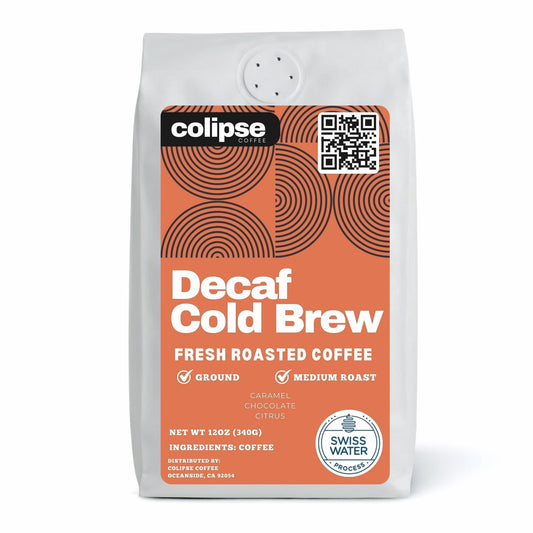
Shop fresh roasted Swiss Water® decaf whole bean coffee from Colipse for any brew method, machine, or caffeine-free recipe. At Colipse Coffee, we offer Swiss Water Process decaf coffee for sale in various origins, blends, and roasts tailored to your brewing style, health needs, and flavor preferences. Our decaf coffee beans start at $21.95 for a 12 oz bag. Bulk options like 2 lb and 5 lb bags offer up to 40% savings. Subscriptions with free U.S. shipping are also available for added value.
How is Organic Decaf Coffee Made?
Organic decaf coffee is made using water-based, chemical-free methods like the Swiss Water Process or Mountain Water Process. These methods soak green coffee beans in hot water to extract caffeine, use activated carbon to filter it out, and reuse the flavor-rich solution to preserve taste while meeting organic standards.
How is Decaf Instant Coffee Made?
Decaf instant coffee is made by decaffeinating green coffee beans using water, solvents, or carbon dioxide before roasting. The beans are then brewed into a strong liquid, which is dried into powder using spray-drying or freeze-drying. This process preserves flavor while removing most caffeine.
Why Do They Make Decaf Coffee?
They make decaf coffee to offer the flavor and benefits of coffee without the stimulating effects of caffeine. The main reasons for decaf coffee are to avoid caffeine-related issues like insomnia, anxiety, and digestive discomfort. Decaf suits people with caffeine sensitivity, pregnant women, and those wanting better sleep.