


Colombian Espresso Coffee Beans
Colombian Espresso Coffee Beans
Couldn't load pickup availability
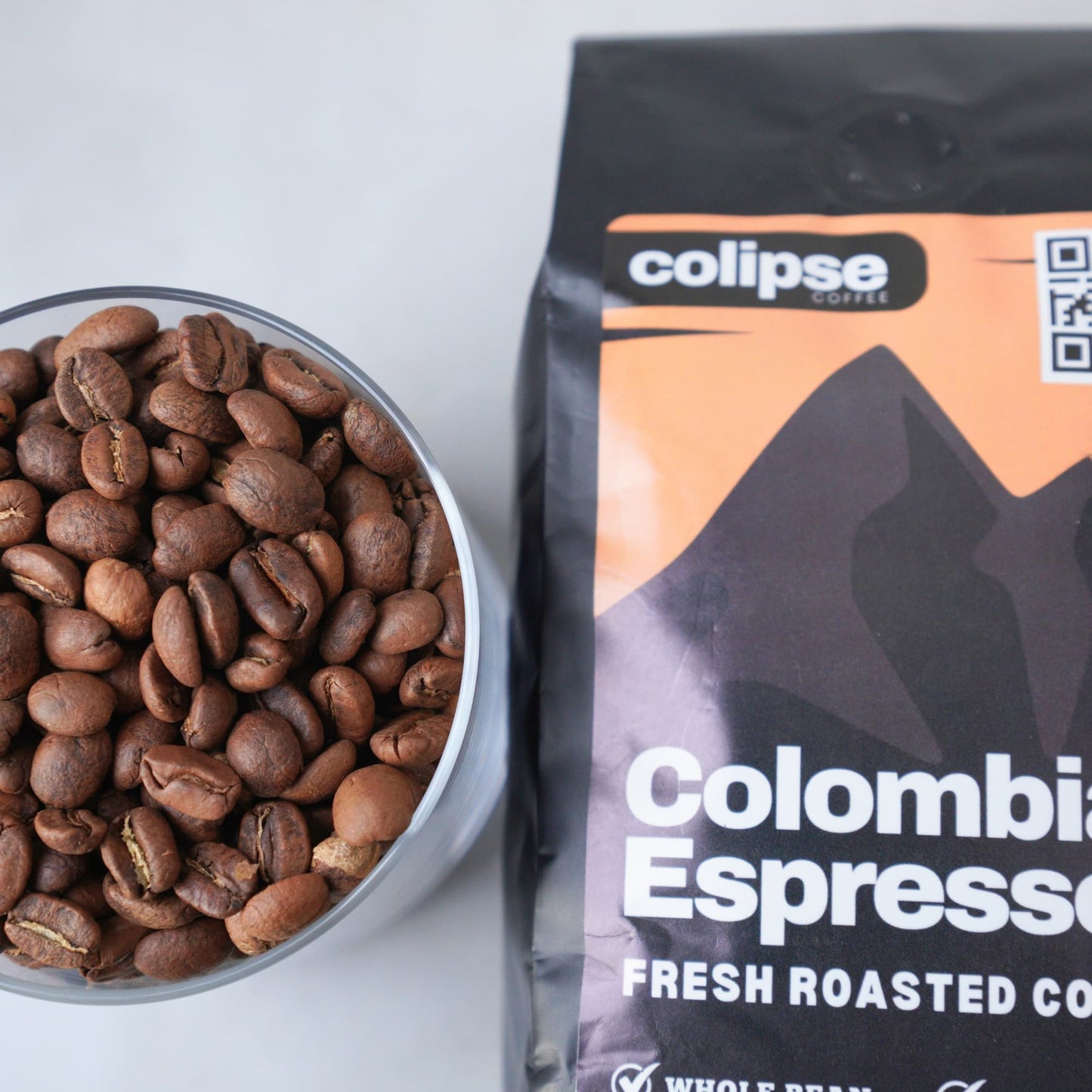
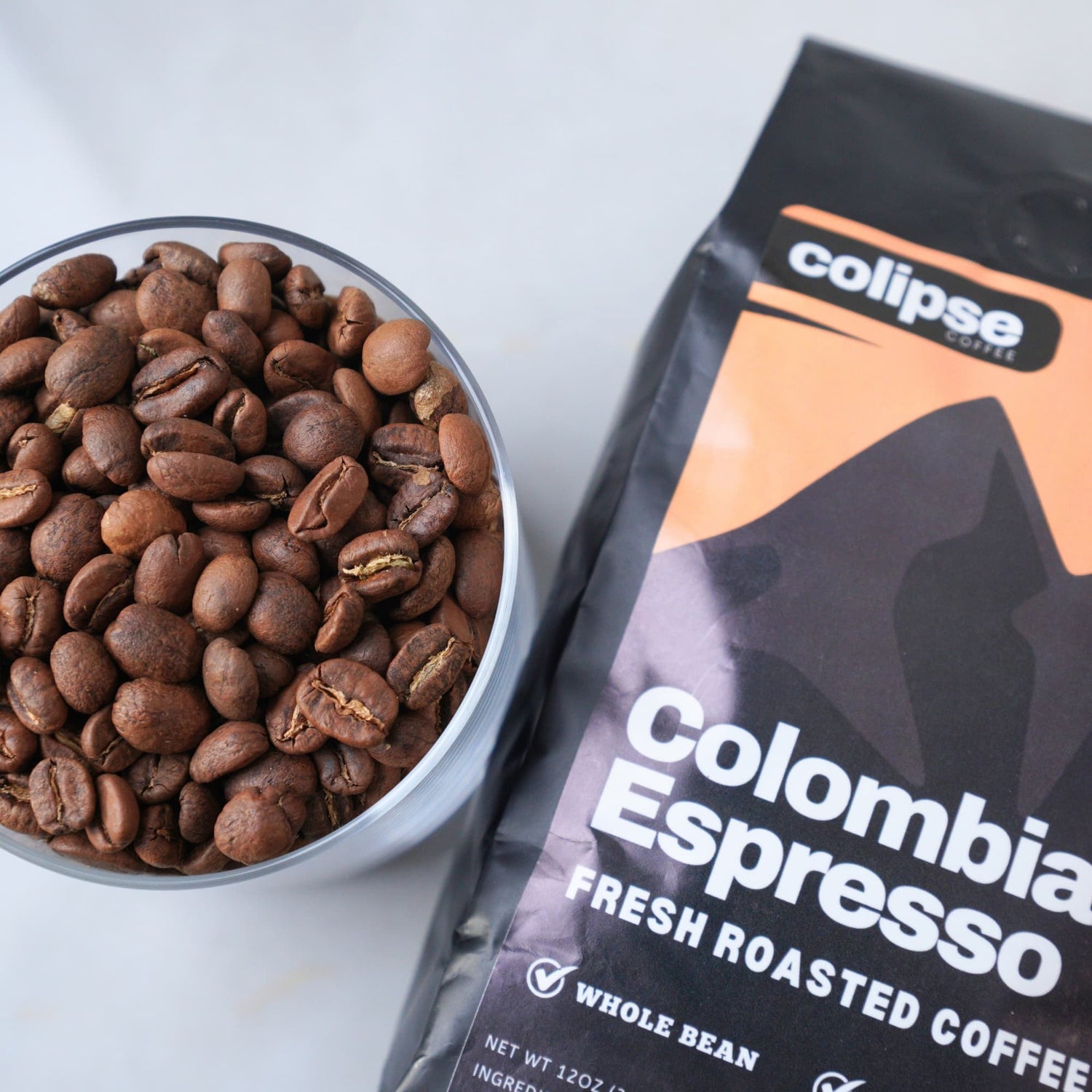
Shop Colipse Colombian Espresso Coffee Beans from the Cafe del Macizo cooperative in Tolima, Colombia. The coffee grows at 1,400 to 2,100 meters above sea level. The cooperative is Fairtrade and Organic certified and includes 60 smallholder farming families committed to quality and ethical practices. Expect dark chocolate, mango, and peach flavors with bright acidity, a smooth rounded body, and excellent espresso performance.
- Region: Tolima, Colombia
- Cooperative: Cafe del Macizo (60 smallholder families)
- Cooperative Certifications: Fairtrade, Organic
- Altitude: 1,400 to 2,100 meters
- Varietals: Caturra, Red Catuai
- Process: Fully washed
- Roast Level: Medium
- Bean Type: 100% Arabica
- Caffeine Content: Regular
- Flavor Notes: Dark chocolate, mango, peach
- Acidity: Bright, juicy
- Body: Rounded, smooth
- Best For: Espresso machines, French press, pour-over
- Coffee Form: Whole bean, Ground
- Grind Size: Whole bean, Coarse, Medium, Fine
- Bag Size: 12 oz, 16 oz, 2 lb, 5 lb




Is Colombian Coffee Good for Espresso?
Yes, Colombian coffee is excellent for espresso, and it's one of the most popular origins for espresso worldwide. Colombian espresso beans offer bright acidity, balanced sweetness, and clean flavor clarity that holds up beautifully to high-pressure extraction.
The high-altitude growing conditions in regions like Tolima (where Colipse sources Colombian espresso) create coffee with the complexity and body needed for exceptional espresso shots. Colombian coffee works particularly well for espresso because washed processing creates clean, transparent flavors that shine in concentrated form.
Why Colombian Coffee Works for Espresso?
High-Altitude Growing Creates Complexity
Colombian espresso beans from Tolima grow at 1,400-2,100 meters above sea level—among the highest coffee-growing regions in the world. High altitude means:
- Slower cherry maturation: 6-9 months vs 4-6 months at lower elevations
- Sugar concentration: Extended ripening allows sugars to concentrate fully
- Temperature variation: Warm days and cool nights stress cherries in beneficial ways
Result: Dense beans with higher sugar content and more complex flavor compounds
When you extract Colombian espresso at high pressure (9 bars in espresso machines), you taste this complexity—dark chocolate, tropical fruit (mango, peach), and bright juicy acidity all present in the same shot.
Washed Processing Creates Clarity
Colombian espresso beans use fully washed processing (also called wet processing), which removes all fruit layers before drying. This creates:
- Clean, transparent flavors: No fermented or fruity "funk"
- Bright, well-defined acidity: Natural acids preserved
- Clear flavor notes: Dark chocolate, mango, and peach don't muddy together
- Excellent for single-origin espresso: You taste terroir, not processing
Compare this to natural-process Ethiopian espresso (fruity, wine-like, sometimes overwhelming) or wet-hulled Indonesian espresso (earthy, heavy body, lower clarity). Colombian washed espresso offers balance, complexity without confusion.
Balanced Acidity and Body
The best espresso balances acidity (brightness) with body (mouthfeel). Colombian espresso delivers both:
Acidity: Bright and juicy, typical of high-altitude beans. Enough brightness to cut through milk in lattes without being sharp or sour in straight shots.
Body: Rounded and smooth. Not as heavy as Indonesian coffee, not as light as some African coffees. Medium body that creates satisfying mouthfeel without overwhelming.
This balance makes Colombian espresso versatile—works for straight espresso shots, milk-based drinks (lattes, cappuccinos), and longer drinks (americanos).
Medium Roast Preserves Origin Character
Many espresso beans are roasted dark (Italian style) to create bold, traditional espresso flavor. Colombian espresso beans work beautifully at medium roast because:
- High-quality beans don't need dark roasting to hide defects
- Medium roast preserves bright acidity and fruit notes
- Origin character (terroir, processing, altitude) remains distinct
- You taste "Colombian coffee" not just generic "espresso"
At Colipse Coffee, Colombian espresso is roasted to medium development specifically to showcase what makes Tolima coffee special, dark chocolate, mango, peach, rather than masking it with roast character.
Colombian Espresso vs Other Origins
vs Italian Espresso Blends:
- Colombian: Single-origin clarity, bright acidity, fruit notes
- Italian blend: Darker roast, heavy body, bold, traditional flavor
vs Brazilian Espresso:
- Colombian: Brighter acidity, more complexity, fruit notes
- Brazilian: Lower acidity, nutty/chocolate flavors, sweeter and simpler
vs Ethiopian Espresso:
- Colombian: Balanced, chocolate + fruit, approachable
- Ethiopian: Very bright, floral/berry-forward, can be overwhelming
When to Choose Colombian Espresso:
- You want balanced shots (not too dark, not too bright)
- You primarily make milk-based drinks (lattes, cappuccinos)
- You prefer fruit notes (mango, peach) with chocolate
- You want single-origin character (terroir) in espresso
- You're new to home espresso (Colombian is forgiving)
At Colipse Coffee, Colombian espresso beans from Tolima deliver exactly what makes Colombian coffee famous: bright acidity, balanced body, clean clarity, and approachable complexity.
What Does Colombian Espresso Coffee Taste Like?
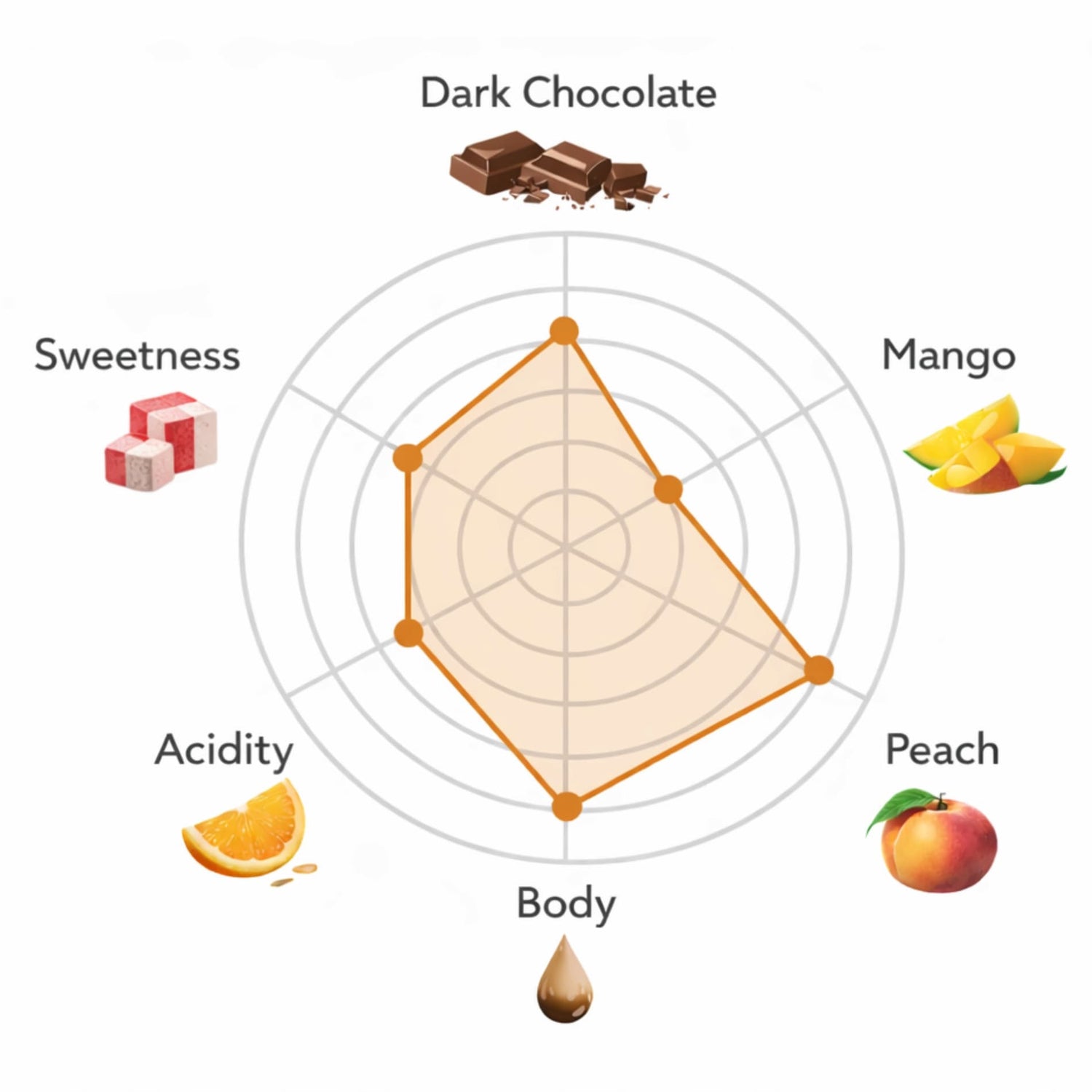
Colombian espresso coffee tastes like dark chocolate, mango, and peach with bright juicy acidity and smooth rounded body. The dominant flavor is rich cocoa (60-70% dark chocolate, not milk chocolate), balanced by tropical fruit sweetness and citrus-toned brightness. Washed processing from Tolima's high-altitude farms (1,400-2,100m) creates clean, transparent flavors—you taste distinct notes rather than muddy generic "espresso." Medium roast preserves these characteristics without masking them with roast character.
Primary Flavor Notes in Colombian Espresso
Dark Chocolate (Dominant Note)
Colombian espresso features rich dark chocolate as the dominant flavor, think 60-70% cacao, not milk chocolate. This cocoa character provides depth and sweetness without bitterness.
Why you taste chocolate: High-altitude beans develop natural sugars during extended maturation. Medium roast creates Maillard reactions that develop chocolate compounds without burning them away (as dark roasts do). The Caturra and Red Catuai varietals grown in Tolima naturally produce chocolate notes.
Brewing impact: Most prominent in espresso (concentrated extraction). Still present in drip or French press but less intense. Chocolate notes are what make Colombian espresso work beautifully in milk-based drinks—creating a natural mocha character.
Mango (Bright Tropical Fruit)
Bright mango character provides juicy sweetness and tropical complexity. Not overpowering—think mango essence rather than fresh mango juice.
Why you taste mango: Washed processing preserves fruit acidity and creates clean, transparent flavors. High-altitude growing (1,400–2,100m) in volcanic soil develops fruit notes naturally. The medium roast preserves these delicate fruit compounds that would be destroyed by darker roasting.
Brewing impact: Most noticeable in the aroma and first sip of espresso. More pronounced in lighter extractions (longer shots, americanos). Adds brightness and complexity that distinguishes Colombian espresso from darker Italian blends.
Peach (Stone Fruit Sweetness)
Subtle peach character adds another layer of fruit sweetness, slightly softer and rounder than mango. Creates an overall impression of tropical fruit when combined with mango notes.
Why you taste peach: Specific to Tolima terroir and the Café del Macizo cooperative’s processing standards. Clean fermentation and sun-drying develop stone fruit notes. Red Catuai varietal contributes natural stone fruit character.
Brewing impact: Emerges in the mid-palate as espresso cools. More noticeable in longer extractions (lungo shots, americanos, pour-over).
Acidity, Body, and Finish
Bright and Juicy Acidity
Colombian espresso has pronounced acidity—bright, juicy, citrus-toned. This is characteristic of high-altitude Colombian coffee and washed processing.
Acidity level: Medium-high. More acidic than Brazilian or Sumatran espresso. Less acidic than Ethiopian or Kenyan espresso. A balanced middle ground.
Why it matters: Acidity provides brightness and life in the cup. In espresso, it balances sweetness and prevents flat shots. In milk drinks, it cuts through milk and prevents muddy flavors. This is why Colombian espresso shines in lattes and cappuccinos.
pH level: Approximately 4.7–4.9 (typical for washed Colombian coffee)
Rounded and Smooth Body
Colombian espresso has medium body—substantial enough for espresso but not heavy. “Rounded” means the mouthfeel is smooth and balanced, without rough edges or astringency.
Comparison:
- Heavier than: Ethiopian, Kenyan (very light body)
- Similar to: Costa Rican, Guatemalan (medium body)
- Lighter than: Sumatran, Brazilian dark roast (heavy body)
Clean, Lingering Finish
The finish is notably clean—no bitterness, astringency, or unpleasant aftertaste when extracted correctly. Cocoa and tropical fruit notes linger on the palate for 20–40 seconds.
Complexity and Cup Clarity
Medium to High Complexity
Colombian espresso offers layered flavors: dark chocolate, mango, peach, bright acidity, rounded body, and clean finish.
High Cup Clarity
Clarity means you can distinguish individual flavor notes rather than tasting muddled flavors. Colombian washed espresso maintains distinct notes even under high-pressure extraction.
Who Will Love This Colombian Espresso
- Espresso enthusiasts seeking single-origin character
- Latte and cappuccino lovers
- Those who prefer balanced espresso
- People who enjoy fruit notes (mango, peach)
- Home baristas wanting forgiving espresso
- Anyone seeking ethically sourced coffee (Fairtrade Organic)
At Colipse Coffee, Colombian espresso beans from Tolima deliver bright, fruity chocolate notes in every cup, roasted fresh to order so these flavors arrive at peak intensity. Experience These Flavors and Order Colombian Espresso Beans.

Washed Processing: How Colombian Espresso Gets Its Clarity
Colombian espresso coffee uses fully washed processing (also called wet processing), which creates the clean flavor clarity, bright acidity, and transparent fruit notes this coffee is known for. Understanding washed processing explains why Colombian espresso tastes the way it does, and why it differs from natural-process or wet-hulled coffees.
What Is Washed Processing?
Washed processing removes all fruit layers from the coffee cherry before drying begins. This creates coffee beans that express terroir, altitude, and varietal character clearly—without fermented fruit flavors interfering.
Step-by-Step Washed Process:
1. Selective Hand-Picking
Farmers at Café del Macizo cooperative hand-pick only ripe red cherries at peak maturation. Selective harvesting—returning to the same tree multiple times as cherries ripen—ensures uniform ripeness.
2. Pulping (Same Day)
Within hours of harvest, cherries are pulped using mechanical pulpers. Pulping removes the outer skin and most fruit pulp, leaving beans covered in sticky mucilage (pectin layer).
3. Fermentation (24–48 Hours)
Beans rest in fermentation tanks filled with water for 24–48 hours. Natural enzymes break down the mucilage. Fermentation time is carefully monitored—too short leaves mucilage, too long creates sour off-flavors.
4. Washing
After fermentation, beans are washed with clean water to remove all remaining mucilage. Washing creates the clean character washed coffees are known for.
5. Sun-Drying
Clean beans (still in parchment layer) are spread on raised drying beds or patios to sun-dry to 10–12% moisture content. Drying takes 7–14 days depending on weather.
6. Dry Milling
Once fully dried, the protective parchment layer is mechanically removed. Beans are sorted, graded, and prepared for export.
Why Washed Processing Creates Better Espresso
Clean, Transparent Flavors
Washed processing removes all fruit mucilage, eliminating fermented or “funky” flavors. The result is clarity—you taste terroir, altitude, and varietal rather than fruit fermentation.
For espresso: Clarity matters because espresso concentrates flavors. Clean processing ensures concentrated extraction highlights dark chocolate, mango, and peach—without muddiness.
Bright, Well-Defined Acidity
Washed processing preserves natural acids developed during cherry maturation. These acids create the bright, juicy acidity Colombian espresso is known for.
For espresso: Acidity provides balance and lift. In milk drinks, it cuts through milk and prevents flat flavor—why Colombian washed espresso excels in lattes and cappuccinos.
Consistency Batch to Batch
Washed processing is more controlled than natural processing. Café del Macizo uses standardized fermentation times, washing protocols, and drying methods.
For you: Every bag of Colipse Colombian espresso tastes consistent. You dial in once and get repeatable results.
Showcases High-Altitude Terroir
By removing fruit influence, washed processing lets terroir shine. You taste:
- Volcanic soil minerals influencing flavor development
- High-altitude complexity from extended maturation
- Tolima region characteristics (tropical fruit notes)
- Distinct varietal character from Caturra and Red Catuai
Washed vs Other Processing Methods
vs Natural Processing (Ethiopian, some Brazilian):
- Washed: Clean, bright, clear flavors, distinct acidity
- Natural: Fruity, wine-like, heavy body, sometimes funky
Colombian washed espresso is more predictable and easier to dial in.
vs Wet-Hulled (Indonesian – Bali, Sumatra):
- Washed: Bright acidity, clean finish, transparent flavors
- Wet-hulled: Low acidity, heavy body, earthy and chocolate notes
Colombian washed espresso works better for milk drinks because brightness cuts through.
vs Honey Processing (Costa Rican):
- Washed: Highest clarity, brightest acidity
- Honey: Sweeter, some fruit character, medium body
Colombian washed espresso delivers maximum transparency of origin character.
At Colipse Coffee, Colombian espresso is sourced specifically from washed-process cooperatives like Café del Macizo because washed processing creates the clarity, brightness, and consistency required for exceptional espresso. Order Washed-Process Colombian Espresso today.

How to Brew Colombian Espresso Coffee
Colombian espresso beans work beautifully across multiple brewing methods, but they truly shine in espresso extraction where high pressure showcases the bright acidity, chocolate notes, and tropical fruit character. Here's how to brew Colombian espresso for each method—with recipes, techniques, and what to expect in your cup.
Colombian Espresso for Espresso Machines (Highly Recommended)
Why Colombian coffee works exceptionally for espresso:
1. Balanced Extraction
Colombian espresso beans from Tolima are forgiving to dial in. Balanced acidity and body mean small adjustments in grind size or temperature don’t dramatically change flavor—ideal for home baristas.
2. Bright Acidity Cuts Through Milk
Juicy, citrus-toned acidity shines in milk-based drinks. Colombian espresso creates exceptional lattes and cappuccinos because brightness prevents flat, muddy flavor when milk is added.
3. Medium Roast Preserves Fruit Notes
Unlike dark Italian espresso, Colombian medium roast maintains mango and peach notes alongside chocolate, creating a more interesting flavor profile.
4. Clean Extraction
Washed processing creates clean-tasting shots with no bitterness, astringency, or unpleasant finish when extracted correctly.
Espresso Recipe for Colombian Coffee:
- Dose: 18–20g (double shot)
- Yield: 36–40g liquid
- Ratio: 1:2
- Time: 25–30 seconds
- Temperature: 200–202°F (93–94°C)
- Pressure: 9 bars
- Grind: Fine (slightly finer than table salt)
Step-by-Step:
- Grind 18–20g finely
- Distribute evenly (WDT recommended)
- Tamp firmly and level (~30 lb pressure)
- Extract 25–30 seconds to 36–40g yield
- Observe flow: dark drops, honey-like stream, and lighter finish
- Serve immediately
What you’ll taste:
- Golden crema
- Dominant dark chocolate with mango and peach
- Juicy, citrus-toned aroma
- Rounded, smooth body
- Clean finish with lingering cocoa and fruit
Dialing In Colombian Espresso:
- Under 25s: Grind finer (sour)
- Over 32s: Grind coarser (bitter)
- Too acidic: Increase temp to 202–204°F
- Too bitter: Decrease temp to 198–200°F
Machine Compatibility:
Semi-Automatic (Breville, Gaggia, Rancilio): Easy to dial in, forgiving extraction.
Super-Automatic (DeLonghi, Jura, Saeco, Philips): Medium roast = non-oily beans, safe for built-in grinders.
Manual / Lever (Flair, La Pavoni, ROK): Allows pressure profiling to highlight acidity or chocolate.
Colombian Espresso for French Press
Why it works: Full immersion highlights chocolate and fruit while maintaining rounded body.
- Coffee: 30g (coarse grind)
- Water: 500ml
- Brew time: 4 minutes
Colombian Espresso for Pour Over
Why it works: Paper filters remove oils, maximizing clarity.
- Coffee: 22g (medium grind)
- Water: 350ml
- Brew time: 2:30–3:00
Colombian Espresso for Cold Brew
Recipe:
- Ratio: 1:7 (concentrate)
- Brew time: 12–18 hours
What you’ll taste: Smooth chocolate, reduced acidity, muted fruit, naturally sweet. Order Colombian Espresso Beans and Choose Your Grind
Choose Your Colombian Espresso Coffee by Size
At Colipse Coffee, we roast every size to order within 24-48 hours. Choose based on your consumption, all sizes ship free within the U.S.

12 oz Bag

16 oz Bag

2 lb Bag

5 lb Bag
Colombian Espresso Coffee - Frequently Asked Questions
Colombian espresso beans are available directly from Colipse Coffee at colipsecoffee.com with free U.S. shipping on all orders.
What's included:
- Single-origin from Tolima, Colombia (Café del Macizo cooperative)
- Fairtrade Organic certified
- Multiple size options (12oz, 16oz, 2lb, 5lb)
- Grind options (whole bean, coarse, medium, fine)
- Roasted to order within 24-48 hours (not pre-roasted inventory)
- Free U.S. shipping (no minimum)
- Subscribe and save 5% on every delivery
Pricing: Currently on sale at $23.50 (regularly $27.99) for 12oz bag. Larger sizes offer better per-ounce value (2lb bag saves 29%, 5lb bag saves 43% vs 12oz pricing).
Why buy from Colipse vs grocery stores:
- Fresher: Roasted within 24-48 hours of order vs weeks/months old in stores
- Single-origin: Traceable to Café del Macizo cooperative vs generic "Colombian coffee"
- Fairtrade Organic: Verified ethical sourcing and organic certification
- Better value: Free shipping + bulk discounts + subscribe and save 5%
Shipping timeline: Orders ship within 3-5 business days. Coffee arrives 7-14 days post-roast (ideal freshness window for espresso).
Grind options: Available as whole bean (recommended for maximum freshness) or pre-ground in fine (espresso), medium (drip/pour-over), or coarse (French press/cold brew).
Proper storage maintains freshness and flavor in Colombian espresso beans—especially important for espresso, where fresh beans produce significantly more crema.
Optimal storage:
1. Keep in original bag (if unopened)
Colipse ships Colombian espresso in vacuum-sealed bags with CO2 one-way valves. This blocks light, moisture, and oxygen.
Unopened: Store in a cool, dark cabinet. Stays fresh 3–5 months unopened.
2. Transfer to airtight container (once opened)
After opening, transfer beans to an airtight container to minimize oxygen exposure:
- Airscape canister (pushes air out)
- Fellow Atmos (vacuum-sealed)
- Mason jar with tight-sealing lid
- Any airtight coffee canister
3. Store in cool, dark location
Kitchen cabinet (away from stove heat), pantry, or dark closet work best.
Avoid:
- Countertop near windows (light exposure)
- Next to oven or stove (heat)
- Above refrigerator (warm air rises)
- Cabinets near dishwasher (humidity)
4. DO NOT refrigerate or freeze (for daily-use coffee)
For coffee you’re drinking within 3–4 weeks, do not refrigerate or freeze. When cold beans are exposed to room air, condensation forms on the surface—this moisture degrades flavor and can introduce off-tastes. Beans also absorb refrigerator odors.
Exception: For long-term storage (3+ months), freezing in airtight bags can preserve coffee, but this is rarely necessary for coffee you’re actively drinking.
Freshness timeline for Colombian espresso:
- Unopened bag: 3–5 months
- Opened, whole bean: 2–4 weeks optimal freshness (drinkable up to 6 weeks)
- Opened, pre-ground: 1–2 weeks optimal
For espresso specifically: Fresh beans (7–21 days post-roast) produce thick, golden crema. After 4–6 weeks, crema production declines noticeably. The coffee remains drinkable but loses texture and visual quality.
Storage tip for espresso: If you brew 1–2 shots daily, a 12oz bag lasts 2–3 weeks—right in the ideal freshness window. Subscribe and save 5% for automatic delivery so you always have fresh beans without running out.
For espresso machines: Strongly recommended to have a grinder—preferably a burr grinder with espresso capability (fine grind settings).
Why a grinder matters for espresso:
- Freshness: Grinding immediately before brewing preserves volatile aromatics and flavor oils. Pre-ground coffee can lose up to 60% of aromatics within 15 minutes and tastes flat within days.
- Crema production: Fresh-ground coffee produces significantly more crema (the golden foam on espresso), adding texture and indicating freshness.
- Dial-in control: Espresso requires precise grind size. Adjusting grind size is the main lever to fix sour (under-extracted) or bitter (over-extracted) shots. Without a grinder, you can’t properly dial in.
Grinder recommendations for espresso:
Entry-level espresso grinders ($140–200):
- Baratza Encore ($140–170) – acceptable for espresso with limitations
- 1Zpresso JX-Pro ($160) – excellent manual grinder, stepless adjustment
- Timemore C3 ($80–100) – budget manual option, decent for espresso
Mid-range espresso grinders ($350–500):
- Baratza Sette 270 ($380–430) – dedicated espresso grinder, fast, stepless
- Eureka Mignon Notte ($350–450) – quiet, consistent
- Fellow Ode with espresso burrs ($300–350) – versatile for espresso and filter
High-end espresso grinders ($600+):
- Niche Zero ($700) – single-dose, zero retention
- Eureka Mignon Specialita ($600–700) – timed dosing, very consistent
- Baratza Vario+ ($500–600) – commercial-grade burrs, highly precise
If you don’t have a grinder:
Colipse offers pre-ground options (fine grind for espresso). However, pre-ground coffee loses flavor quickly and produces less crema. Use within 1 week of opening for acceptable quality.
For other brewing methods (French press, pour-over, drip):
A grinder is still beneficial but less critical. Pre-ground medium or coarse options work acceptably because these methods are more forgiving than espresso.
Bottom line: If you’re serious about espresso, invest in a quality burr grinder. If budget is tight, start with pre-ground fine from Colipse while saving—but prioritize getting a grinder for the best espresso experience.
Yes, Colombian espresso beans work excellently in super-automatic espresso machines (bean-to-cup machines with built-in grinders).
Compatible with all major brands:
- DeLonghi: Magnifica, Dinamica, La Specialista
- Jura: E6, E8, S8, Z6, Z8
- Saeco: PicoBaristo, Xelsis, Intelia
- Philips: 3200, 4300, 5400 series
- Gaggia: Accademia, Anima, Brera
- Breville: Oracle Touch, Barista Touch
Why Colombian espresso is ideal for super-automatics:
Medium Roast = Non-Oily Beans
Very dark roasts produce oily beans that can clog built-in grinders and cause mechanical issues. Colombian espresso’s medium roast develops full flavor without excessive surface oil. Beans remain dry and free-flowing—safe for super-automatic grinders.
Balanced Flavor Works with Automatic Settings
Super-automatic machines use pre-programmed grind size, temperature, and water volume. Colombian espresso’s balanced profile works well with default settings, delivering good results without expert adjustment.
Good Crema Production
Even with built-in grinders and pressurized brewing systems, Colombian espresso produces satisfying crema thanks to fresh roasting and high-quality beans.
Consistent Results
Washed-process Colombian coffee offers strong batch-to-batch consistency. Once your machine is set, results remain repeatable without constant re-dialing.
Which grind to order for super-automatics:
- Machine has built-in grinder: Order whole bean (recommended for maximum freshness)
- Machine without grinder: Rare for super-automatics—order fine grind for espresso
Usage tip:
Super-automatic machines go through beans quickly (18–20g per double shot). If using 2–3 shots daily:
- 12oz bag lasts ~2 weeks
- 2lb bag lasts ~5–6 weeks (best value)
Consider subscribing and saving 5% for automatic delivery every 4–6 weeks so you never run out.
Cleaning note:
Clean your brew group weekly and descale every 2–3 months. Medium-roast Colombian espresso won’t leave oily residue, but regular cleaning keeps your machine performing at its best.
Colombian espresso beans from Colipse are excellent for lattes and cappuccinos—often better than darker Italian espresso blends for milk-based drinks.
Why Colombian coffee excels in milk drinks:
Bright Acidity Cuts Through Milk
Colombian espresso has juicy, citrus-toned acidity that prevents flat, muddy flavor when milk is added. Many dark espresso blends lose character in milk; Colombian espresso maintains distinct flavor even with 8–10 oz of milk.
Fruit Notes Remain Present
Mango and peach notes stay noticeable in milk, creating a natural “fruity mocha” character—chocolate base with tropical fruit complexity, without syrups.
Dark Chocolate Base Pairs with Milk
The dominant dark chocolate note provides a familiar espresso foundation that milk enhances rather than hides. Chocolate + milk creates a natural mocha effect.
Clean Finish, No Bitterness
Washed processing delivers a clean aftertaste with no lingering bitterness. Many darker roasts taste harsh in milk drinks; Colombian espresso stays smooth and balanced.
Naturally Sweet
High-altitude growing develops natural sugars. Many customers use less sugar—or none at all—because the coffee itself tastes sweet.
Latte Recipe with Colombian Espresso:
- Pull double shot: 18–20g beans, 36–40g liquid, 25–30 seconds
- Steam 10 oz milk to 140–150°F with silky microfoam
- Pour milk over espresso
Result: Bright, fruity latte with chocolate base and clean finish.
Cappuccino Recipe:
- Pull double shot (same specs)
- Steam 4 oz milk with drier foam
- Traditional 1:2 coffee-to-milk ratio
Result: Bold cappuccino with fruit complexity, thick foam, and chocolate notes.
Flat White Recipe:
- Pull double ristretto: 18g beans, 30g liquid
- Steam 4 oz milk to create wet, silky microfoam
- Pour microfoam over espresso
Result: Strong coffee flavor with fruit and chocolate complexity, velvety texture.
Comparison to Italian dark roast for milk drinks:
- Italian dark roast: Bold, traditional, one-dimensional, can taste bitter in milk
- Colombian medium roast: Bright, complex, fruit + chocolate, naturally sweet, clean finish
If you primarily make milk-based drinks (lattes, cappuccinos, flat whites), Colombian espresso from Colipse is the better choice.
Which size to order:
- 1–2 lattes daily: 2 lb bag (lasts 5–6 weeks, best value)
- 3+ drinks daily: 5 lb bag (lasts 8–10 weeks, maximum savings)
Colombian espresso coffee contains approximately 120–150mg of caffeine per double shot (2oz)—typical for 100% Arabica espresso.
Caffeine by serving:
- Single espresso shot (1oz): 60–75mg caffeine
- Double espresso shot (2oz): 120–150mg caffeine
- Latte (12oz, double shot + milk): 120–150mg caffeine
- Cappuccino (6oz, double shot + milk): 120–150mg caffeine
- Americano (8oz, double shot + water): 120–150mg caffeine
Caffeine in other brewing methods:
- French press (8oz): 90–100mg caffeine
- Pour-over (8oz): 95–100mg caffeine
- Drip coffee (8oz): 95–100mg caffeine
- Cold brew (8oz, diluted): 150–200mg caffeine
What affects caffeine in espresso:
- Dose amount: More coffee = more caffeine (20g contains more than 18g)
- Extraction ratio: Longer shots (1:2.5–1:3) extract slightly more caffeine
- Brew time: Longer extraction (30–35 seconds) extracts marginally more caffeine
- Roast level: Lighter roasts have slightly more caffeine than darker roasts (about 5–10% difference)
Colombian vs other coffees:
- Colombian Arabica: 1.2–1.4% caffeine by weight
- Robusta (common in Italian espresso blends): 2.2–2.7% caffeine by weight
Colombian espresso is 100% Arabica, so it contains typical Arabica caffeine levels—about 50% less than Robusta-containing blends, with significantly better flavor quality.
Is Colombian espresso high in caffeine?
No. It has average caffeine content for Arabica espresso. The bold flavor and bright acidity may taste strong, but the caffeine level is standard and lower than Robusta-based Italian blends.
Caffeine comparison:
- Starbucks Pike Place (12oz): ~235mg caffeine
- Starbucks doppio espresso (2oz): ~150mg caffeine
- Colipse Colombian espresso (2oz): 120–150mg caffeine
- Red Bull (8.4oz): 80mg caffeine
For higher caffeine:
If you specifically want more caffeine, cold brew made with Colombian espresso beans delivers approximately 150–200mg per 8oz (diluted 1:1). Cold brewing extracts more caffeine than most hot methods.
Yes, Colombian espresso beans work beautifully in French press, pour-over, and other brewing methods—not just espresso machines.
“Espresso beans” refers to roast profile and intended use, not a brewing restriction. Colombian espresso beans are medium-roast, high-quality Colombian coffee optimized for espresso extraction, but they perform excellently across all brewing methods.
French Press
- Grind: Coarse
- Ratio: 30g coffee : 500ml water (1:16.7)
- Water temperature: 200°F (93°C)
- Brew time: 4 minutes
What you’ll taste: Dark chocolate and tropical fruit notes, rounded body, bright acidity softened by immersion brewing, clean finish despite oils passing through the metal filter.
Why it works: Medium roast provides body without muting fruit. Washed processing keeps flavors clean even in full immersion.
Pour-Over (V60, Chemex, Kalita Wave)
- Grind: Medium (granulated sugar)
- Ratio: 22g coffee : 350ml water (1:16)
- Water temperature: 202°F (94°C)
- Brew time: 2:30–3:00 minutes
What you’ll taste: Maximum clarity with distinct chocolate, mango, and peach notes. Bright, juicy acidity and a clean, sweet finish.
Why it works: Paper filters remove oils, allowing washed-process clarity to shine.
Drip Coffee Makers
- Grind: Medium
- Ratio: 60g coffee : 1 liter water (1:16.7)
What you’ll taste: Balanced cup with chocolate and fruit notes, bright acidity, ideal for daily brewing.
Cold Brew
- Grind: Coarse
- Ratio: 100g coffee : 700ml water (1:7 concentrate)
- Brew time: 12–18 hours (room temperature or refrigerated)
What you’ll taste: Smooth chocolate, reduced acidity, muted tropical fruit, naturally sweet and clean. Dilute 1:1 before drinking.
Why Colombian Espresso Beans Work in All Methods
- Medium roast is versatile and not over-developed
- Specialty-grade, Fairtrade Organic beans taste good regardless of method
- Washed processing creates clean, adaptable flavors
- Balanced profile: bright but not sharp, bodied but not heavy
Should You Use “Espresso Beans” for French Press or Pour-Over?
Absolutely. The only difference is roast optimization—not bean type. Colombian espresso beans are simply high-quality, medium-roast Colombian coffee from Tolima and work exceptionally well in any brewing method.
Grind Size Guide
- Whole bean: Recommended for maximum freshness
- Fine grind: Espresso, moka pot, Turkish coffee
- Medium grind: Pour-over, drip coffee, AeroPress
- Coarse grind: French press, cold brew, percolator
Order the grind that matches your brewing method—or choose whole bean and grind fresh for best results.
How does Colombian espresso compare to Sumatra or Ethiopian coffee for espresso?
Colombian espresso from Tolima sits between Sumatran and Ethiopian coffees on the flavor spectrum—offering balance that many espresso drinkers prefer.
Colombian Espresso vs Sumatra for Espresso
| Characteristic | Colombian (Tolima) | Sumatra Mandheling |
|---|---|---|
| Processing | Washed (wet-process) | Wet-hulled (Giling Basah) |
| Acidity | Bright, juicy | Very low, almost flat |
| Body | Medium, rounded | Very heavy, syrupy |
| Flavor | Chocolate, mango, peach | Earthy, tobacco, cedar |
| Finish | Clean, sweet | Earthy, lingering |
| Best for | Milk drinks, balanced shots | Straight espresso, heavy body lovers |
Choose Colombian over Sumatra if:
- You primarily make lattes or cappuccinos
- You prefer clean, fruity flavors over earthy ones
- You want balanced espresso rather than ultra-heavy body
- You’re new to single-origin espresso
Choose Sumatra over Colombian if:
- You want the heaviest body possible
- You enjoy earthy, bold Indonesian character
- You need very low-acid coffee
- You drink straight espresso shots
Colombian Espresso vs Ethiopian for Espresso
| Characteristic | Colombian (Tolima) | Ethiopian (Yirgacheffe) |
|---|---|---|
| Processing | Washed | Washed or Natural |
| Acidity | Bright, balanced | Very bright, complex |
| Body | Medium, rounded | Light to medium |
| Flavor | Chocolate, mango, peach | Floral, berry, tea-like |
| Complexity | Medium–high | Very high |
| Best for | Milk drinks, balanced shots | Straight shots, adventurous palates |
Choose Colombian over Ethiopian if:
- You prefer chocolate as the dominant note
- You want more body and weight in espresso
- You make milk-based drinks
- You want approachable, balanced complexity
- You’re new to single-origin espresso
Choose Ethiopian over Colombian if:
- You love bright, fruity, floral coffees
- You want maximum complexity and uniqueness
- You drink straight espresso shots
- You’re experienced with single-origin espresso
Summary
- Sumatra: Earthy, heavy, low-acid (most different from Colombian)
- Colombian: Balanced, chocolate + fruit, clean (middle ground)
- Ethiopian: Floral, berry, very bright (most different from Colombian)
Colombian espresso from Colipse offers the “Goldilocks” option—balanced acidity, medium body, chocolate plus fruit, and a clean finish. It’s versatile for any drink style and approachable for any skill level, while still delivering true single-origin complexity.
If you want to explore all three, Colipse offers:
- Colombian Espresso (this page)
- Bali Blue Moon (Indonesian wet-hulled, brighter than Sumatra)
- Ethiopia Guji (coming soon – bright, fruity Ethiopian)
Yes, Colombian espresso beans are excellent for beginners learning home espresso—often the best origin to start with.
Why Colombian Espresso Is Ideal for Beginners
1. Forgiving Extraction Window
Colombian espresso tolerates small mistakes in grind size, brew temperature, and extraction time better than many other origins. Shots that run slightly fast or slow still taste good.
- Light Ethiopian: Under-extracted = very sour; over-extracted = harsh and astringent
- Dark Italian: Under-extracted = weak; over-extracted = very bitter
This tolerance is why Colombian espresso is widely used in cafés for training new baristas.
2. Balanced Flavor Profile
Bright acidity balanced by chocolate notes and medium body means:
- Not overly acidic if slightly under-extracted
- Not burned or harsh if slightly over-extracted
- Approachable flavors (chocolate and fruit, not floral or earthy extremes)
3. Visual Feedback: Reliable Crema Production
Fresh Colombian espresso produces consistent golden crema, helping beginners learn visually:
- Good shot: Golden crema, ~2–3mm thick, lasts 2+ minutes
- Under-extracted: Pale, thin crema that fades quickly
- Over-extracted: Dark, thin crema with bitter taste
4. Works Across Machine Types
- Entry-level: Breville Bambino, DeLonghi EC685
- Mid-range: Gaggia Classic Pro, Breville Barista Express
- Super-automatic: All bean-to-cup machines
- Manual/lever: Flair, ROK
Colombian espresso doesn’t require extreme precision that basic machines can’t deliver.
5. Medium Roast = Non-Oily Beans
Medium roast beans stay dry and free-flowing, making them safe for built-in grinders and super-automatic machines. Very dark roasts can clog grinders and cause issues.
6. Naturally Sweet
High-altitude Colombian beans develop natural sweetness. Beginners often add sugar to hide bitterness—Colombian espresso usually doesn’t need it.
Beginner Learning Path with Colombian Espresso
Weeks 1–2: Dial-In Basics
- Learn grinding, dosing, distribution, tamping
- Get familiar with your machine
- Forgiving shots make learning less frustrating
Weeks 3–4: Refine Extraction
- Dial grind to reach 25–30 second shots
- Learn to read crema and taste balance
- Reliable feedback speeds improvement
Weeks 5–8: Milk Drinks
- Practice steaming milk and microfoam
- Learn latte art
- Bright acidity cuts through milk clearly
Month 3+: Experiment
- Try Ethiopian or Sumatran espresso
- Use Colombian as your flavor baseline
Beginner Equipment Pairings
- Entry-level ($300–500): Breville Bambino Plus + 1Zpresso JX-Pro
- Mid-range ($700–900): Breville Barista Express or Gaggia Classic Pro + Baratza Sette 270
- Super-automatic ($600–1,200): DeLonghi Magnifica, Philips 3200, Jura E6
Colombian espresso from Colipse performs well with all of these setups.
Buying tip: Start with a 12oz bag to learn and dial in. Once consistent, move up to a 2lb bag for better value.
Bottom line: If you’re new to home espresso, Colombian espresso beans are the best place to start—balanced, forgiving, approachable, and versatile. Master technique with Colombian first, then explore other origins with confidence.